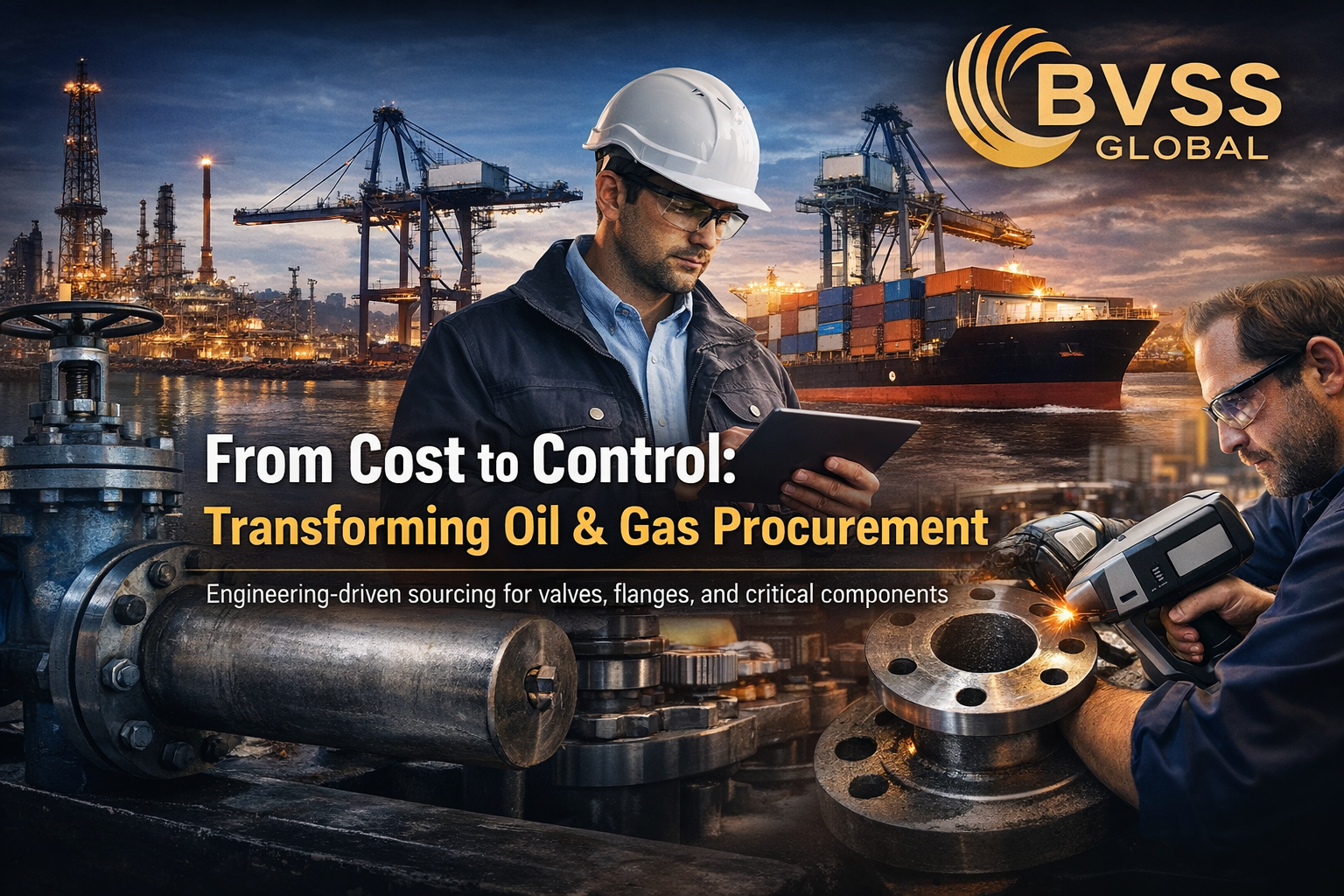
From Cost to Control: Why Oil & Gas Procurement Must Evolve Beyond Low-Cost Sourcing
In today’s oil & gas environment, procurement is no longer a cost center—it is a strategic lever for operational reliability, safety, and profitability.
For decades, organizations have relied heavily on low-cost sourcing from global hubs such as India and China, particularly for critical components like valves and flanges. While this approach delivered short-term savings, it has also introduced significant risks—quality inconsistencies, delayed shipments, compliance failures, and hidden lifecycle costs.
Forward-thinking companies are now shifting toward engineering-driven, risk-aware procurement models—where performance, traceability, and reliability outweigh initial purchase price.
The Hidden Cost of “Low-Cost” Procurement
At first glance, sourcing valves and flanges from low-cost regions appears financially advantageous. However, the true cost often extends far beyond the invoice.
Common Hidden Costs
- Rework and replacement due to quality failures
- Project delays caused by late deliveries
- Expediting fees and emergency sourcing
- Inspection and compliance overhead
- Warranty claims and operational downtime
For critical industries such as oil & gas, a single component failure can lead to millions in losses, safety risks, and reputational damage.
Procurement decisions must be evaluated through a Total Cost of Ownership (TCO) lens—not just upfront pricing.
Key Challenges in Global Sourcing (India & China Focus)
-
Quality Variability and Certification Risks
Despite advancements in manufacturing capabilities, variability remains a persistent challenge:
- Inconsistent metallurgy and heat treatment
- Casting defects and tolerance deviations
- Questionable authenticity of certifications (API, ASTM)
Without robust validation, organizations risk installing components that meet documentation—but fail in real-world conditions.
-
Limited Process-Level Visibility
Most procurement models rely on final-stage inspection, which is often too late.
Critical issues originate earlier:
- Raw material sourcing
- Forging and casting processes
- Machining tolerances
Without process-level QA, defects go undetected until delivery—or worse, after installation.
-
Geopolitical and Trade Uncertainty
Global sourcing is increasingly influenced by:
- Trade restrictions and tariffs
- Regulatory changes
- Geopolitical tensions
These factors introduce unpredictability in:
- Lead times
- Landed costs
- Supplier continuity
-
Logistics Complexity and Delays
Long international supply chains bring:
- Port congestion and customs delays
- Freight cost volatility
- Limited shipment visibility
For project-driven industries, delays directly impact commissioning timelines and revenue realization.
-
Documentation and Traceability Gaps
Traceability is critical in oil & gas, yet many organizations struggle with:
- Incomplete Mill Test Certificates (MTCs)
- Missing heat numbers
- Poor documentation integrity
This creates compliance risks during audits and inspections.

Why Traditional Procurement Models Are No Longer Sufficient
Historically, procurement success was defined by:
- Lowest cost
- Supplier availability
- Delivery timelines
Today, that model is outdated.
Modern procurement must answer:
- Will the component perform under extreme conditions?
- Is the supplier reliable across multiple projects?
- Can risks be predicted and mitigated before impact?
From transactional purchasing → to strategic, engineering-driven procurement.
The New Standard: Engineering-Led Procurement
Leading oil & gas companies are adopting a new approach—one that integrates engineering, quality, and procurement into a unified strategy.
Core Principles
Process-Based Quality Assurance
- Multi-stage inspections (raw material → production → final)
- Material verification (PMI, NDT)
- Supplier process audits
Supplier Capability Validation
- Technical audits beyond certifications
- Evaluation of manufacturing infrastructure
- Performance benchmarking
Multi-Source and Risk Diversification
- Reducing dependence on a single geography
- Developing alternative supplier networks
- Strategic sourcing models
Digital Visibility and Control
- Real-time tracking of orders and shipments
- Supplier performance dashboards
- Integrated procurement systems
The Strategic Impact for C-Level Leaders
When procurement evolves, the business benefits are significant:
Operational Excellence
- Reduced downtime
- Improved project reliability
- Higher equipment performance
Financial Performance
- Lower lifecycle costs
- Improved margins
- Reduced cost overruns
Risk Mitigation
- Fewer supply chain disruptions
- Better compliance and audit readiness
- Stronger supplier resilience
Where BVSS Global Fits In
At BVSS Global, we believe procurement should go beyond sourcing—it should deliver certainty, performance, and long-term value.
Our approach is built on:
- We don’t just source components—we ensure they are engineered to perform under real operating conditions.
- From raw material verification to final inspection, we implement end-to-end QA processes that eliminate uncertainty.
- We evaluate suppliers not just on cost, but on capability, consistency, and compliance.
- By aligning with modern digital frameworks, we enable clients to achieve visibility, control, and scalability in their procurement operations.
Conclusion: Procurement as a Competitive Advantage
In an industry where reliability is non-negotiable, procurement can no longer operate as a back-office function.
It must evolve into a strategic capability that drives performance, reduces risk, and enables growth.
Organizations that continue to prioritize cost alone will face increasing challenges. Those that embrace engineering-led, risk-aware procurement will gain a decisive advantage in an increasingly complex global landscape.